Posts

Showing posts with the label black walnut

Roast Duck with Onion Sauce
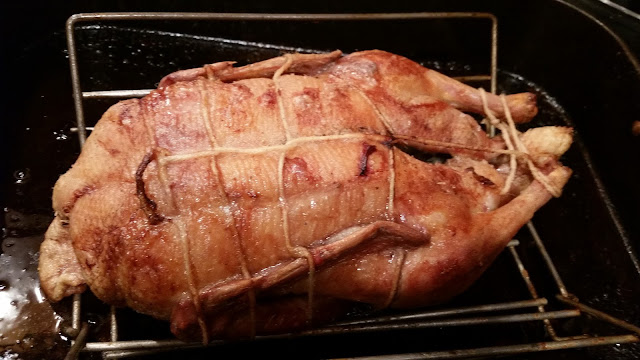
Image
   Roast Duck Challenge #5:  Roasts   They’re a staple of the historic table, in many different shapes and forms and types. It’s also a cooking technique. Try a historic recipe for a roast, or a recipe that involves roasting, and tell us how it turned out. This challenge was a bit more, um, challenging.  I had already made a roast beef for the first challenge (meat and potatoes) and puzzled over what to make.  I wanted to try something totally different and chose duck. The Recipe, Year and Region Today's recipe comes from The Virginia Housewife by Mrs. Mary Randolph, published in 1838 in Baltimore.  Some people consider it to be the first truly American cookbook.   There are actually several recipes involved We also need to make onion sauce as an accompaniment From the Virginia Housewife, 1838 Let's Cook! How Did You Make It:         Ingredients:     1 whole duck, app...

Black Walnut Catsup

Image
One more look at black walnuts in the 19th-century.  My previous posts focused on the amazing coloring properties of the husk.  Today it is time to look at the black walnut as food. I was very intrigued and a bit puzzled at the number of references to black walnut catsup/ketchup in cookbooks of the time.  Today tomato catsup is the sole survivor of a variety of catsups: tomato, grape, lemon, mushroom, cucumber, oyster, tomato, and black walnut, to name a few.  It is a shock to modern sensibility to realize that "ketchup" or "catsup" (both spellings were used) simply meant a vinegar based sauce.   The American Heritage Dictionary gives a good definition:                             Word History:  The word  ketchup  exemplifies the types of modifications that can take place in borrowing both of words and substances. The source of our word  ketchup  may be the Malay ...

Black Walnut Dye

Image
yarn and undersleeves dyed in black walnut The first way I became acquainted with black walnuts in a historic context was as a dye agent.  When I first started reenacting, I was searching for something I could display.  I had read Ersatz in the Confederacy, by Mary Elizabeth Massey, and was fascinated by some of the ingenious ways people were able to make do.  The idea of using plants you found around you to dye wool and cotton fascinated me and I entered an experimental phase during which any possible dye plant was chopped up and thrown into my dye pot. My research turned up many references to black walnut as a well-known dye.  One of its advantages was that its tannic nature meant it did not require a mordant, or chemical agent, to make the dye stable.   The North American Sylva, or a Description of the Forest Trees of the United States, Canada, and Nova Scotia, Vol 1,   by F. Andrew Michaux mentions that the husk of the black walnut was used ...

Black Walnut Ink

Image
Black walnuts heating on the fire One of the reasons I gathered black walnuts the other day was to make ink from their husks.  Although the name would make you guess the ink color to be black, it is actually a lovely brown.  Black walnut ink is a historic ink, along with inks made from oak galls and logwood.  I am planning on bringing my black walnut ink to the  reenactment of the  150th Battle of Chickamauga in September 2013.  I like the idea of using a homemade "make do" ink to illustrate a time when the people of the area were stretched near their limits to obtain supplies and manpower. The husk is the outmost green covering (although it may have turned brown or even a rotten black when you harvest it).  It has a pungent tannic smell and will stain your fingers as it starts to decay or if you try cutting it away from the nut.  The inner woody shell and the nutmeat itself will not color anything, nor will the English walnut you can purc...

Dealing With Black Walnuts

Image
It's nearly autumn and the black walnuts are starting to fall.  I spent an hour today gleaning fallen nuts and broken bits of husks.  Black walnuts are used in many ways during the 1800s, so I try to keep an eye open for them.  Because squirrels are very fond of the nuts, it's often a race, although I am looking for the green outer husk.  I don't begrudge the squirrels the nuts, but little bits of husk strewn across the ground are so much harder to harvest.  I do want to be sure to get them before they have rotted away, so timing is important. I brought my harvest home and put them in a large pot to soak over night so I can use them for my next project.  I'll have to be sure to cover the pot tightly or move it into the shed overnight so the local squirrels don't raid them. The Black Walnut tree is a native North American tree.  This beautiful botanical print comes from the work The North American Sylva, or a Description of the Forest Trees of the U...