Posts

Showing posts with the label knitting

A Knitting Heritage

Image
Part of dealing with a family death is making decisions about possessions - what to keep, what to sell, what to discard.    Depending upon your attitude towards possessions and your sentimentality, the decisions can be very difficult. After visiting our parents' graves this Christmas, my brother and I made a quick stop at our family home.  There is much to go through, much to sort, much to decide.  I realized one very easy decision would be about my mom's knitting needles.  I have very little sentimentality about them, although I did learn to knit on them.  Knitting needles are tools; I knit, so taking her supply seemed logical. I was actually looking for Mom's knitting needle roll, but I didn't find it this trip.  To simplify matters, I stuffed all the odds and ends into a shopping bag and brought them back home with me.  I frequently see old knitting needles in thrift store, having been bundled off along with the rest of the unwanted...

Knitting "A Comfortable Comforter"

Image
My latest project was a period scarf or comforter.  This very easy scarf is shaped to be narrower around the neck and wider where it crosses on the chest.  Both the shaping and shorter length make it a scarf to be worn inside the coat.   I had already made my husband a scarf, but thought he might also like one in a light weight that would be more shapeable. After I completed it, I realized this scarf would fulfill the requirements for the Historical Sew Fortnightly   Challenge  Generosity & Gratitude.  The challenge was  "about celebrating the generosity of spirit and willingness to help others that makes the historical sewing community great, and giving credit and thanks to those who have contributed to our collective knowledge without expecting payment in return."  Scanned on-line books are such an incredible resource to anyone involved in recreating historical items! These references take us from vague imaginings cobbled together from...

Black Walnut Dye

Image
yarn and undersleeves dyed in black walnut The first way I became acquainted with black walnuts in a historic context was as a dye agent.  When I first started reenacting, I was searching for something I could display.  I had read Ersatz in the Confederacy, by Mary Elizabeth Massey, and was fascinated by some of the ingenious ways people were able to make do.  The idea of using plants you found around you to dye wool and cotton fascinated me and I entered an experimental phase during which any possible dye plant was chopped up and thrown into my dye pot. My research turned up many references to black walnut as a well-known dye.  One of its advantages was that its tannic nature meant it did not require a mordant, or chemical agent, to make the dye stable.   The North American Sylva, or a Description of the Forest Trees of the United States, Canada, and Nova Scotia, Vol 1,   by F. Andrew Michaux mentions that the husk of the black walnut was used ...

Knit Undersleeves, part 2

Image
The undersleeves are completed! I wore them to a reenactment and they helped keep my arms warm, which was the goal. If I made these again, I think I would chose a color, perhaps brown or gray. Woven undersleeves were usually white, but knit ones did not have to be. White is not as practical for camping and cooking over an open fire. Despite the dirt issue, I was very pleased with the way they turned out. I used (American) size 2 and 5 needles and fingering weight wool to knit them. (For the pattern and the beginning of the saga, see the September blog) I did discover a different problem with the undersleeves. The coat sleeves of my wool dress are fairly slim, so I selected this undersleeve pattern because they are snug on the arms. Unfortunately, the coat sleeves tended to push the sleeve down my arm and make them bunch up around my wrist area.

Brioche stitch

The undersleeves are coming along. I have lost count of how many times I ripped out the pattern part on the cuff - 10? 12? - but now I'm working away on the main part of the sleeve. Which doesn't explain why I took a detour to learn the brioche stitch. I was searching through period knitting patterns on Google books and kept running across the brioche stitch. It didn't sound all that hard - throw the yarn to the front, slip one, knit 2 together, repeat to the end. Repeat for the 2nd row. It took me most of the evening to reach the "aha!" moment and figure out how to do it. It is used in many garments for warmth with flexibility. The problem is that it sounds like you would be decreasing all along - and if there was a yarn over to keep the number of stitches equal, it should make little picot holes. Off to modern instructions to decipher the period ones! But, every set of modern instructions I could find involved knitting with an even number of stitches; the perio...

Knit Undersleeves

Image
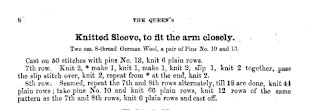
My current project is a pair of knit undersleeves from The queen's winter knitting book , by Mrs. Mee & Miss Austin. I am part of a knit-along that worked on this project, however, due to a broken arm in the spring, I am woefully behind. I am now at the stage of "knit behind" rather than "knit along." Oh, I know I could simply start the new project, but I am more interested in this one. I am making mine out of white fingering weight wool. So far I have ripped them out twice, largely because 2 mysterious stitches keep showing up on my needles. An undersleeve is a second sleeve worn under the outer dress sleeve. Warm weather sleeves are made from light-weight white fabrics such as organdy or lawn. Undersleeves serve a practical purpose; they keep body oils off of the fashion fabric and can be washed and bleached (the reason for using white fabric). Many dresses are made of wool or silk and cannot be washed, so protecting the fabric is very important....