Posts

Showing posts with the label cooking

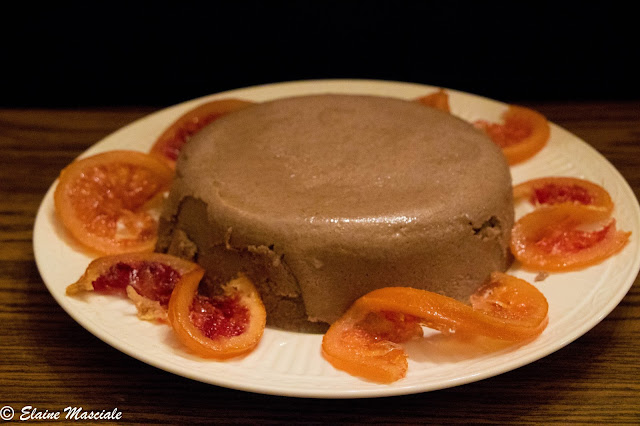
Candied Orange Peel

Image
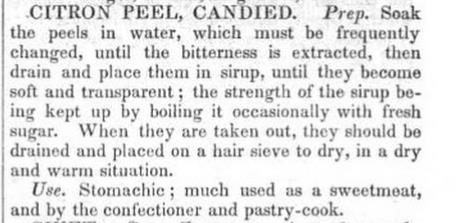
It's January and that means decreased levels of sunlight, lots of cold, and an upswing in illness across the board.  Christmas decorations are down and put away, leaving surroundings duller and grayer.  It's also peak time for citrus (this assumes you remember when fruits and vegetables were sold seasonally in the grocery stores). We have been eating a lot of oranges this winter.  I have been collecting the peels in a water-filled plastic zip top bag in our refrigerator,  When the bag reaches the desired level, it is time to make candied orange peel.  There is no hard or fast level - it totally depends upon how large a batch you want to make at a time and if you have the time free for candying. Historic Recipe Let's start with the historic recipe (A Cyclopaedia of Six Thousand Practical Receipts, Arnold James Cooley, New York, 1856) How to Make It! To actually make these, I used some modern techniques. Place the orange peels in a heavy-bottomed sa...

Kitchen Pepper

Image
Last fall I decided to make some kitchen pepper.   What is that, I hear you say?  Kitchen pepper is a basic seasoning mix that seems to have been fairly popular in the nineteenth century, based on its inclusion in historic cookbooks.  I encountered the concept of Kitchen Pepper a number of years ago when I read my first reproduction cookbook, The Kentucky Housewife (1839).  Unlike its designation as a "pepper," the actual product is a mix. I tucked it away in the back of my mind, where it stayed as I started learning how to cook historic recipes.  In the meantime, I made walnut catsup, lemon catsup, and mushroom catsup.  The idea of other seasonings intrigued me.  Plus, I wanted an interesting demonstration for a reenactment.  So, one lovely October weekend, I, with the help of friends, made kitchen pepper. The Kentucky Housewife Making the Kitchen Pepper I started with whole, dried ingredients, including blades of mace, which I...

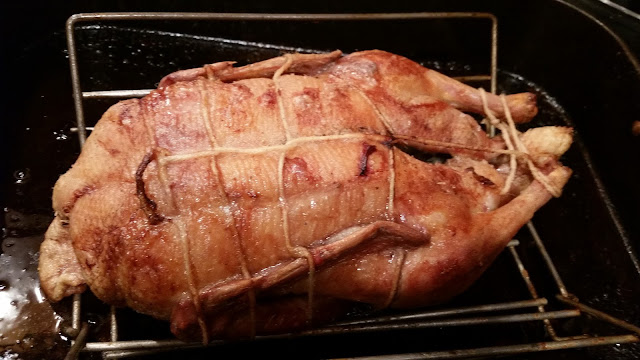
Roast Duck with Onion Sauce

Image
   Roast Duck Challenge #5:  Roasts   They’re a staple of the historic table, in many different shapes and forms and types. It’s also a cooking technique. Try a historic recipe for a roast, or a recipe that involves roasting, and tell us how it turned out. This challenge was a bit more, um, challenging.  I had already made a roast beef for the first challenge (meat and potatoes) and puzzled over what to make.  I wanted to try something totally different and chose duck. The Recipe, Year and Region Today's recipe comes from The Virginia Housewife by Mrs. Mary Randolph, published in 1838 in Baltimore.  Some people consider it to be the first truly American cookbook.   There are actually several recipes involved We also need to make onion sauce as an accompaniment From the Virginia Housewife, 1838 Let's Cook! How Did You Make It:         Ingredients:     1 whole duck, app...

Union Cake (and some Gluten Free Recipes!)

Image
Union Cake Today, February 12th, being Abraham Lincoln's birthday, it seemed particularly apt that we bake Union Cake.   A Presidential birthday celebration was not my original goal, circumstances just aligned nicely to work out that way. HISTORICAL FOOD FORTNIGHTLY CHALLENGE #3 : History Detective  For this challenge, you get to be the detective! Either use clues from multiple recipes to make a composite recipe, or choose a very vague recipe and investigate how it was made. SELECTING A RECIPE I spent a number of weeks reading old cookbooks trying to find a recipe that I found puzzling  and appealing enough to make.    For my primary source I chose Moore's Rural New Yorker , an agricultural weekly paper  from the area of Rochester, NY.   As I read the various issues, I found myself getting caught up in the responses from the  readers.  Emily sends her method of heeling and toeing a stocking and asks for a good frosting...
Image
Chocolate Cream Historical Food Fortnightly Challenge #2 - Culinary Vices! The Challenge :   Culinary Vices (January 15 - January 28)   Some foods are really, really naughty. Globs of butter, lashings of sugar and syrup, decadent chocolate and wine. Bring out your naughty, indecorous side with foods associated with all the bad things, in the best ways. Being a child of the twentieth century, I know what I consider to be decadent (chocolate!  whipped cream!  rich creaminess!) and being a student of the nineteenth century, I know that my tastes do not necessarily align with theirs.  Many of their desserts are not as sweet and naturally, few rely on refrigeration - I do qualify "few," because there are desserts, such as ice cream, which require chilling. Boiled puddings there are aplenty on both shores of the Atlantic Ocean, as well as cakes like our fruit and pound cakes.   Mrs. Isabella Beeton That type of dessert didn't strike me as...

Baked Beef and Potatoes - A Historical Food Fortnightly Recipe

Image
Today, I take on another Historical Food Fortnightly Challenge (#1 of the new series) Baked Beef with white and sweet potatoes The Challenge 1. Meat-and-Potatoes    They’re a staple for the tables in the most rustic cottages as well as the fanciest banquet tables - and it’s also an idiom meaning a staple or the most basic parts of something. Make a historic “meat-and-potatoes” recipe - however you interpret it. I decided to work with the narrow, classic definition of meat as beef/veal, pork and mutton/lamb.  Game, poultry or fowl, and fish/shellfish form their own categories.  Not having to rely on seasonality of period storage options, I decided on beef - roast beef in particular.   Selection of a recipe proved harder than I expected.  Wanting to keep 1865 as my end limit, I found that many cookbooks had rather small sections on beef cookery.  Most of the ones I examined advised boiling the beef for an hour or two before transferring to th...