Posts

Showing posts with the label reenacting

A Delicate Butter Cookie
Image
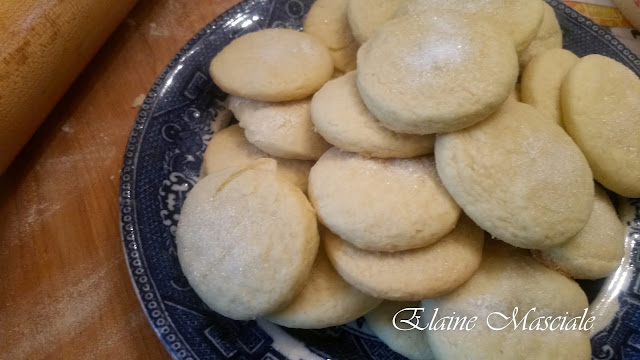
I thought I would try another cookie this week.  I was drawn to this recipe because it had sugar sprinkled on top, which seems like a very contemporary touch.  Because there is no flavoring extract, the cookie flavor is delicate, tasting primarily of butter and sugar. The Recipe This recipe comes from The Genesee Farmer , Vol XX, February 1859. The Ingredients The first ingredients on the list are pretty straight forward - a cup of butter, 2 cups of sugar, 4 eggs.  I set the butter and eggs out to come to room temperature. The sour milk - per standard substitution, I made my own sour milk.  I measured 1  2/3 T of milk into a glass and added 1 t of lemon juice.  I stirred the milk and lemon juice together and let them sit for roughly 5 minutes.   Saleratus is a leavening agent that both precedes and is concurrent with baking soda. I used a 1 to 1 substitution and used 1 t of baking soda. Flour.  You will notic...

No.1 Ginger Snaps

Image
Ginger was one of the most popular flavors for baked goods in the 19-century. Recipes for gingerbread and ginger cookies abound.  This recipe for "No. 1 Ginger Snaps" is a lovely example. The Recipe Add caption This recipe comes from  The Practical Cookbook , by Mrs. Bliss (Philadelphia, 1860),  The recipe is titled "Number 1" simply because it is immediately followed by Number 2 Ginger Snaps, Sources and Differences The Southern Gardener and Receipt Boo k, third edition, by Mrs. Mary L. Edgeworth (Philadelphia, 1860) provides an identical recipe, instructing the baker to add "enough flour to make a soft dough."  The New Family Book or Ladies' Indispensable Companion and Housekeepers' Guide  (New York, 1854) and The Improved Housewife  (Hartford, Conn, 1844) also include the recipe, but with a significant difference - the instructions are "to add as much flour as can be rolled into the mixture."  The amount of...

Candied Orange Peel

Image
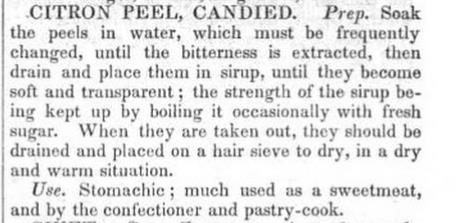
It's January and that means decreased levels of sunlight, lots of cold, and an upswing in illness across the board.  Christmas decorations are down and put away, leaving surroundings duller and grayer.  It's also peak time for citrus (this assumes you remember when fruits and vegetables were sold seasonally in the grocery stores). We have been eating a lot of oranges this winter.  I have been collecting the peels in a water-filled plastic zip top bag in our refrigerator,  When the bag reaches the desired level, it is time to make candied orange peel.  There is no hard or fast level - it totally depends upon how large a batch you want to make at a time and if you have the time free for candying. Historic Recipe Let's start with the historic recipe (A Cyclopaedia of Six Thousand Practical Receipts, Arnold James Cooley, New York, 1856) How to Make It! To actually make these, I used some modern techniques. Place the orange peels in a heavy-bottomed sa...

Eggs and Tomatoes

Image
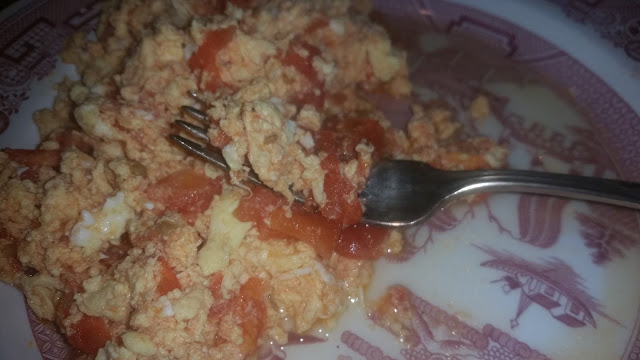
Stewed tomatoes for breakfast - a very British thing.  Also a very breakfast thing in nineteenth-century America.  Eggs and Tomatoes comes from Mrs. Bliss's 1850 volume, The Practical Cookbook  (Philadelphia).  It's not a seasonal thing for me right now, since, being April, it's not tomato season. The Recipe To facilitate peeling the tomatoes, I put them into boiling water to blanch them.  Once the skins split, I removed them with a slotted spoon, removed the skins, halved them, removed the seeds, and then rough chopped the remainder Blanched tomatoes I melted two tablespoons of butter in a frying pan, added the chopped tomatoes, and let them cook.  I added salt and pepper to taste. Since the tomatoes were already warmed from the blanching, this didn't take very long.  I beat six eggs with a fork as if I was making scrambled eggs. Pour the eggs into the stewed tomatoes and begin stirrin...

Kitchen Pepper

Image
Last fall I decided to make some kitchen pepper.   What is that, I hear you say?  Kitchen pepper is a basic seasoning mix that seems to have been fairly popular in the nineteenth century, based on its inclusion in historic cookbooks.  I encountered the concept of Kitchen Pepper a number of years ago when I read my first reproduction cookbook, The Kentucky Housewife (1839).  Unlike its designation as a "pepper," the actual product is a mix. I tucked it away in the back of my mind, where it stayed as I started learning how to cook historic recipes.  In the meantime, I made walnut catsup, lemon catsup, and mushroom catsup.  The idea of other seasonings intrigued me.  Plus, I wanted an interesting demonstration for a reenactment.  So, one lovely October weekend, I, with the help of friends, made kitchen pepper. The Kentucky Housewife Making the Kitchen Pepper I started with whole, dried ingredients, including blades of mace, which I...

A Yoked Dress

Image
It was time to make a new dress, something I seldom do.  My reenacting wardrobe is more driven by necessity than stylish desire.  My mother had passed away in March and I decided to wear second-stage mourning in her honor.  Full mourning, involving all black clothing and a black bonnet with a long black mourning veil would take more time than I had to pull together, having only a month between my mother's death and a national event at Shiloh.    We had obligations to attend the event, so remaining home wasn't an option.     Since reenacting involves a healthy dose of make-believe, there is no way for others, be they reenactors or spectators, to know one is not simply showing a mourning impression (pretending to be in mourning), and women in full mourning are often met with insensitive or callous comments.  For those reasons I decided to wear a lighter stage of mourning, one that involves black and white, gray, and lavender.   ...

Going to a Civil War Civilian Symposium!

Image
Today is a travelogue, and who doesn't like going on a road trip?  A couple of weeks ago we went to the Genteel Arts Symposium in Harrisburg, Pennsylvania.  It was my second time to attend, although a couple of years had passed since my first trip.  This time I was accompanied by my best friend - my husband.  Road trips are always better with congenial company!  Being mid-March, the weather was rainy most of the way. Civilian conferences or symposiums (or whatever you wish to call them) are outstanding ways to increase your knowledge of your chosen time period.  When your hobby is reenacting, you may feel isolated at home. feeling like your friends and extended family lovingly deal with you and your "eccentricity."There, there, don't get Auntie going on that history stuff again.  You know how she gets!"  As a civilian reenactor, you don't even have the excuse of gunpowder to explain your fascination with living history. Have you ever explain...